


Here is the thing about infrastructure. Nobody talks about it until it is too late. By then you are forced to adopt what others built instead of being part of the conversation that invented it.
When OpenRTB launched in 2010, most people in advertising ignored it. A few engineers understood what it meant. A handful of companies built on it early. Those companies now run the programmatic industry. Everyone else spent the next decade playing catch-up.
Something similar is happening right now. It is moving faster. The stakes are a bit higher. And this time the infrastructure is not just changing how ads get bought. It is changing what an ad even is and how it impacts the customer’s purchasing journey.
Between October 2025 and March 2026, several protocols were released that together describe how AI agents will discover, negotiate, and purchase on behalf of consumers.
Agents are software that can take a goal and execute a multi-step workflow to achieve it without a human approving each step. You tell an AI assistant to find you a waterproof jacket under $180 and buy it. The LLM powered chatbot researches options, picks one, and completes the purchase. You never opened a browser. You never saw an ad. You never navigated a checkout flow.
That scenario is not hypothetical. It is happening today inside ChatGPT.
The questions it creates for advertising is fundamental. The ad does not need to be seen anymore. It needs to win the recommendation. That is a completely different game and it requires completely different infrastructure.
THE PROTOCOLS
Before getting into how they work together, here is what each one actually is.
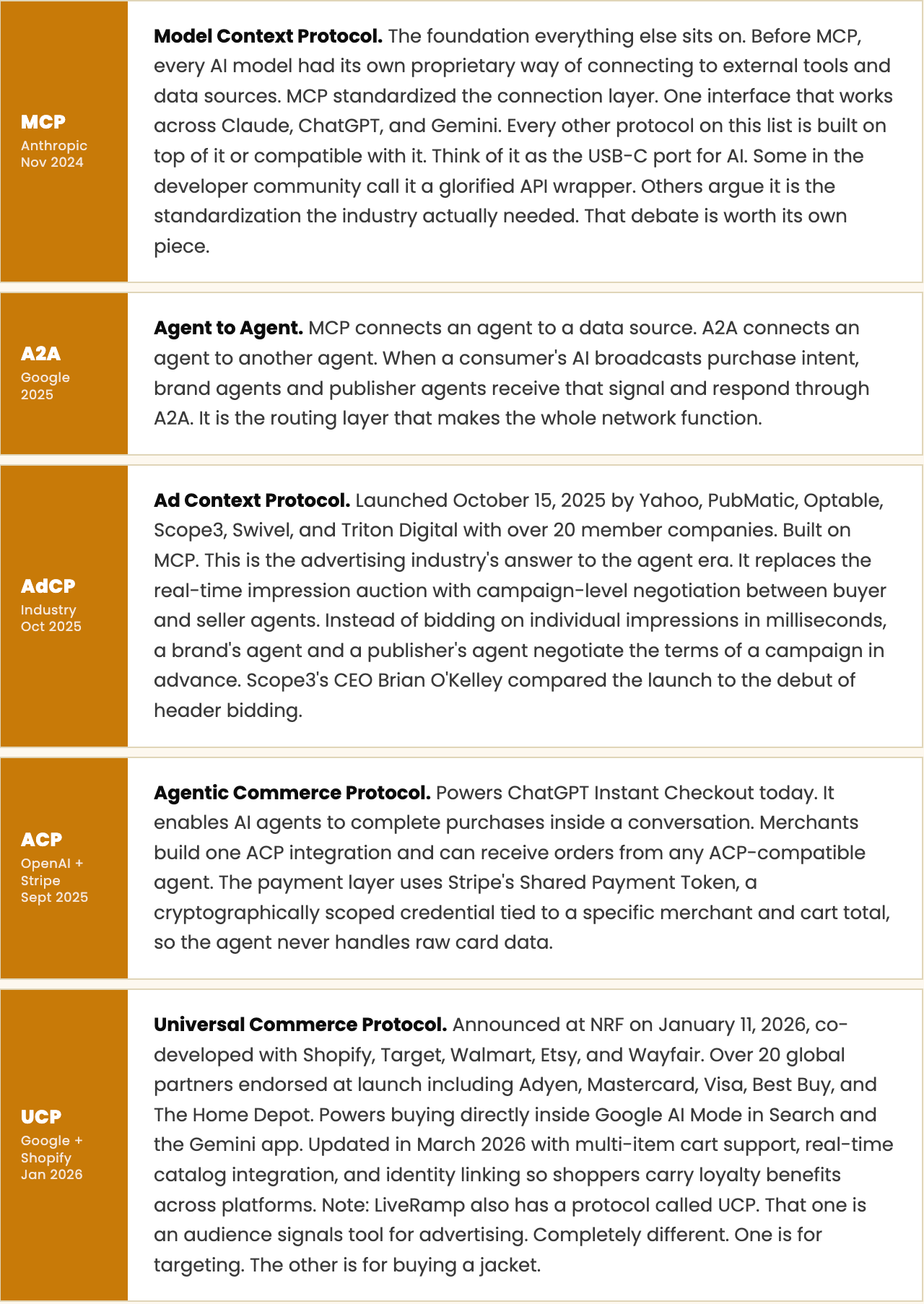
HOW AN ACTUAL TRANSACTION RUNS
The best way I understand how these protocols work together is to follow a single transaction from beginning to end, both what the user experiences and what is actually happening underneath it.
Someone opens ChatGPT and types: I’m hiking in Seattle next week. I need a good waterproof shell jacket under $180.
From the user’s perspective the experience is frictionless. Three seconds later GPT recommends a Patagonia Torrentshell at $179, notes it is a sponsored result, and asks if they want to buy it. They say yes. A checkout widget appears inside the chat showing the total, their saved address, and the last four digits of their payment method. One tap. Done. The jacket arrives Tuesday. The user never left the conversation.
Here is what actually ran underneath that.
The LLM’s first move was not to search for jackets. It used MCP to pull context silently in the background. Seattle weather next week. The user’s saved size preferences. Their shipping address. Their previous purchase history. All of that happened before any external call was made.
Then for a commercially motivated query like this, the platform routed an intent signal through A2A. Brand agents at Patagonia, Arc’teryx, and REI were listening. Each one evaluated the query against their active AdCP campaign contracts. This is the part that is fundamentally different from the old model. There was no millisecond auction. No bid request firing. Patagonia’s campaign terms were already negotiated in advance. The agent just matched the query to the contract.
Patagonia’s agent responded with a structured AdCP payload. Campaign priority score. SKU. Waterproofing specs. A promotional offer. Sustainability data. The AI evaluated all three payloads against the user’s stated need and selected Patagonia. The sponsored label was attached. The user saw it. They said yes. At that point AdCP’s job was finished.
The AI switched layers. It called Patagonia’s ACP endpoint with the SKU, size, and shipping address. Patagonia’s backend verified inventory, calculated tax, and returned a finalized checkout session. If this were a Google Gemini session, UCP would have handled the same coordination handoff, with Google Pay as the payment surface rather than Stripe. However, both can run on the same underlying rails.
The user confirmed the cart. Stripe issued a Payment Intent scoped to Patagonia, for this exact cart total, valid one time only. The AI passed the client secret to Patagonia’s backend. Patagonia processed the payment through Stripe. The AI never saw the card number. If anything in the cart had changed, the token would have been invalid and the transaction would have failed at the payment layer. The security is baked into the architecture, not bolted on afterward.
Patagonia returned an order confirmation and tracking link through ACP. The AI surfaced it in chat. Patagonia remained the merchant of record.
The entire loop from stated need to purchase confirmation happened inside one conversation. No browser. No website. No ad that the user consciously processed.
The harder question is what happens when commercial incentives and user intent are not aligned. You may get a sponsored recommendation after a commercially motivated query, but that raises a problem both OpenAI and Google are actively working through. How do you balance surfacing the most relevant product against one that is objectively worse but whose advertising agent is willing to bid higher? In a traditional auction model that tension was managed by quality scores. In an agentic model nobody has cleanly solved it (yet).
ACP VS UCP
ACP and UCP solve the same problem. They are direct competitors. The winner will not be decided by which one is technically better. It will be decided by who controls the ecosystem.
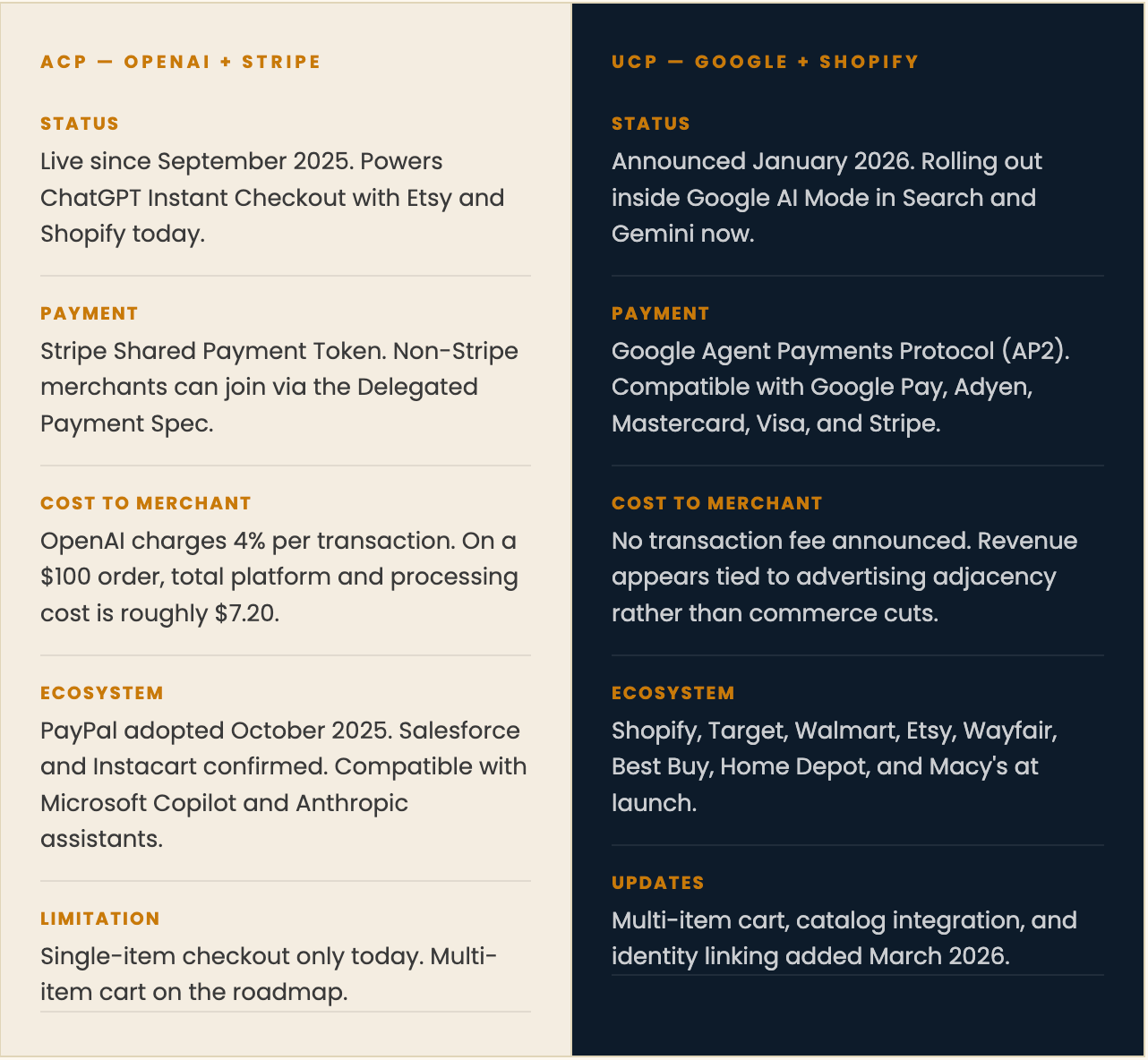
For most merchants the practical answer is to support both. ACP reaches 700 million weekly ChatGPT users. UCP reaches Google AI Mode and Gemini. Amazon is building its own ecosystem through Rufus and Alexa+ and has joined neither protocol.
After ChatGPT Instant Checkout launched, Amazon updated their robots.txt to block OpenAI crawlers and removed 600 million products from ChatGPT’s shopping results. That move tells you a lot about how Amazon sees what is being built here.
Just last month we saw Amazon and Open AI develop a strategic partnership primarily focused on AWS but I’m sure the commerce bit is being heavily discussed.
WHERE ADOPTION ACTUALLY STANDS
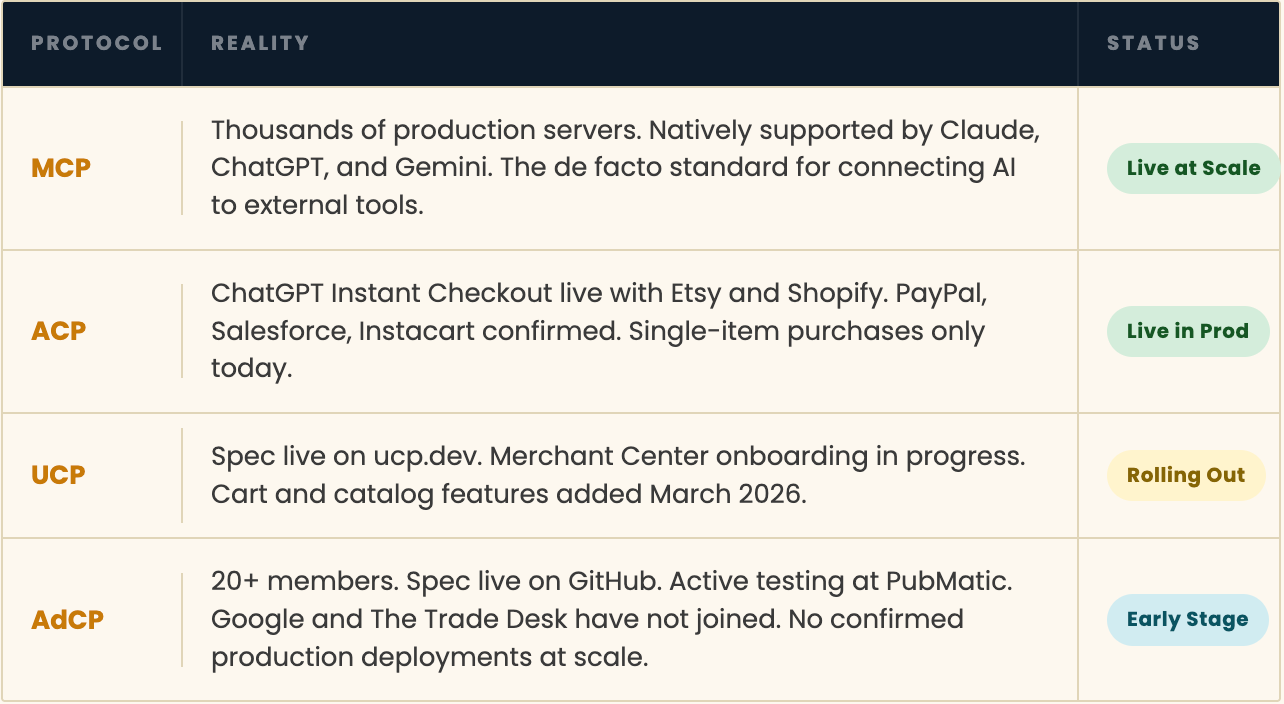
MCP is the only protocol on this list that is fully mature. Thousands of production servers. Natively supported by all three major model providers. The de facto standard for connecting AI to external tools.
ACP is the only protocol on this list where a consumer can complete a purchase through an AI agent at meaningful scale today. Everything else is infrastructure being built in advance of volume that has not arrived yet. That is not a criticism. OpenRTB was in the same position in 2011. The companies that built on it early are the ones running the programmatic industry today.
The most important thing to understand about AdCP’s adoption status is who is missing. Google has not joined. The Trade Desk has not joined.
Those two names represent a significant share of programmatic demand. A supply-side without buy-side commitment is a specification, not a marketplace. The history of ad-tech standards includes well-designed protocols that never reached scale because the platforms controlling demand had no incentive to adopt them.
That is the challenge AdCP needs to work through as incentives are not aligned.
THE CLOSING TAKE
Protocol transitions in advertising take time but they tend to be permanent. OpenRTB took about three years from introduction to becoming the dominant mechanism for programmatic trading. The companies that built on it early established advantages they still hold today. The companies that waited built their strategies on infrastructure that someone else owned.
ACP is live. UCP is rolling out. People are buying things inside conversations today. The advertising layer is chasing a commerce layer that launched six months ahead of it.
The protocols are the infrastructure. The infrastructure is the leverage. The question every company in this industry needs to answer is which layer of this stack they are building on, which layer they are competing in, and which layer they are about to find themselves on the wrong side of.
The ones who wait for the dust to settle will be finding out which side of the stack they ended up on.
Thank you for reading The Ad Graph.