


I’ve been wrestling with the idea of owning real estate in the ad tech world, and how as we shift to walled gardens and the open web slowly dies, everything becomes pay to play and login to win. Owning the estate matters so much more than having the “best” ad tech engine.
The long-term problem was never that The Trade Desk picked a fight with the holdcos. It was that Trade Desk had no inventory of its own and no advertiser relationship of its own. The holding companies brought the demand. So when they pulled back this year, Trade Desk lost flow it had only ever rented. WPP and Dentsu pulled out of OpenPath, and Publicis stopped recommending TTD to its clients. As the walls went up, Trade Desk positioned itself as the key that unlocks the gardens, and the gardens had no interest in being unlocked. Trade Desk rented both ends. A toll booth with someone else’s road on both approaches.
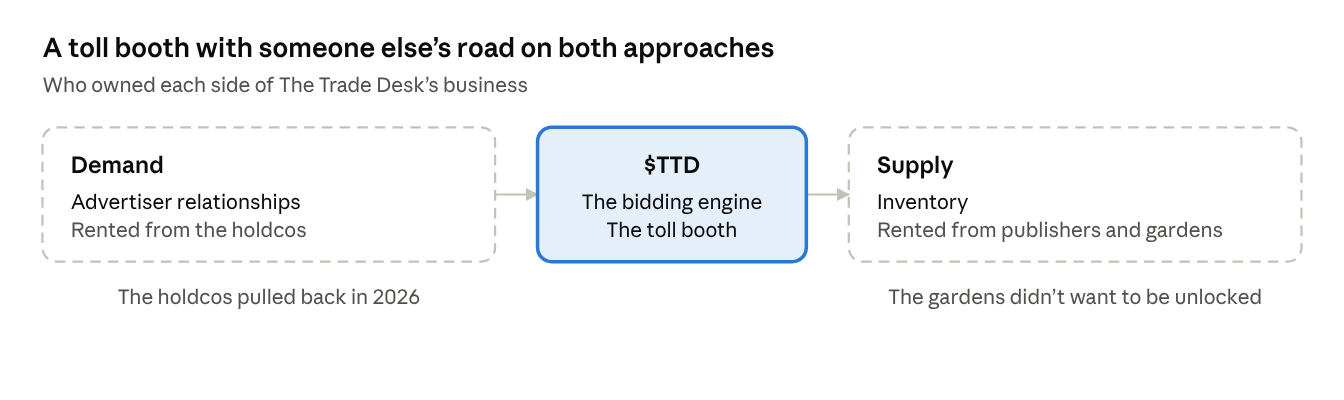
Who owned each side of The Trade Desk’s business
Before I upset anyone, I think AppLovin is a great company run by phenomenal people. It’s also the obvious pushback to this whole idea. AppLovin bought game studios to train its models, then sold the entire apps business in 2025. What it kept was MAX, the mediation auction where the ad money actually clears.
Whereas Unity owns the engine the games get built in, and AppLovin still beat it. Unity owned the workshop. AppLovin owned the till. While this is the case for now, you can see that AppLovin has started to create its own apps to monetize. As discovery is changing, its better to be inside the garden than outside it.
Now we look at the giant Meta. They own their inventory, and they are probably the best discovery engine that exists or will exist across their first party estate.
But when discovery shifts to chatbots, and I’m looking at Google, OpenAI and Anthropic, agentic discovery and commerce become different. Now owning the catalog becomes even more important, because you have discovery but conversion is happening elsewhere on Amazon, Shopify, etc.
OpenAI tried to fix this with Shopify. Instant Checkout let ChatGPT present a product and have the user purchase agentically while OpenAI observed the transaction rather than owned it. It shut down in March after very few merchants ever went live.
Meta launched Shops because they wanted to own everything end to end, and that backfired as merchants didn’t want it. Now Meta has the best discovery engine and the best first party ad estate, but every transaction happens off platform. But wait. Enter Muse. With Muse, the transaction can happen right within the platform, and the Shopify integration shows it. Meta sees the sale, the merchant stays merchant of record, and Meta charges no fee. But they are again renting the catalog.
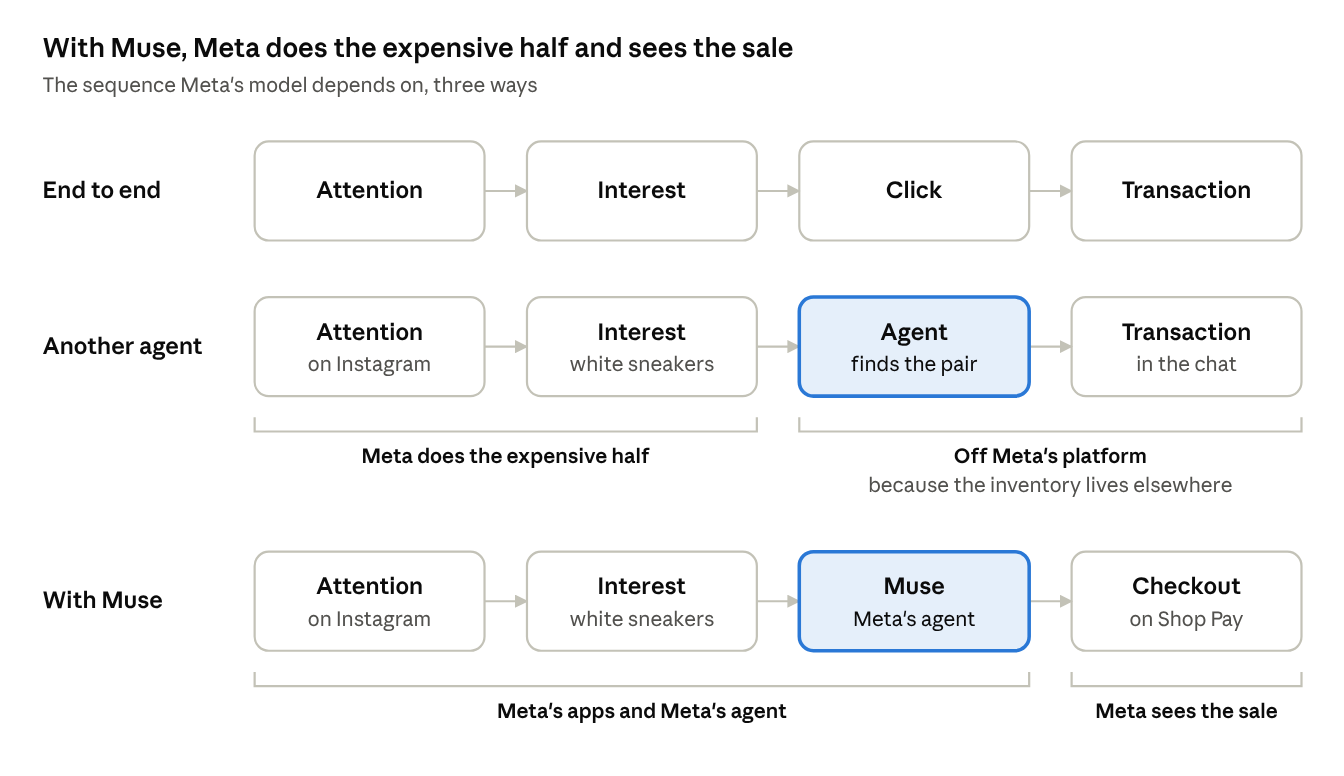
Where an agent cuts in, and where Muse fits
So Meta now observes the transaction instead of owning it. In the agentic future, is that enough to keep CPMs from compressing? As the discovery engine, does it need to own the catalog, or just be able to observe the purchase? Or does it eventually buy its own merchant platform? And will merchants even allow it? Amazon already blocked Muse. Amazon excels here because they own the catalog, the engine and the inventory, and you can see it in the tremendous growth of their advertising business.
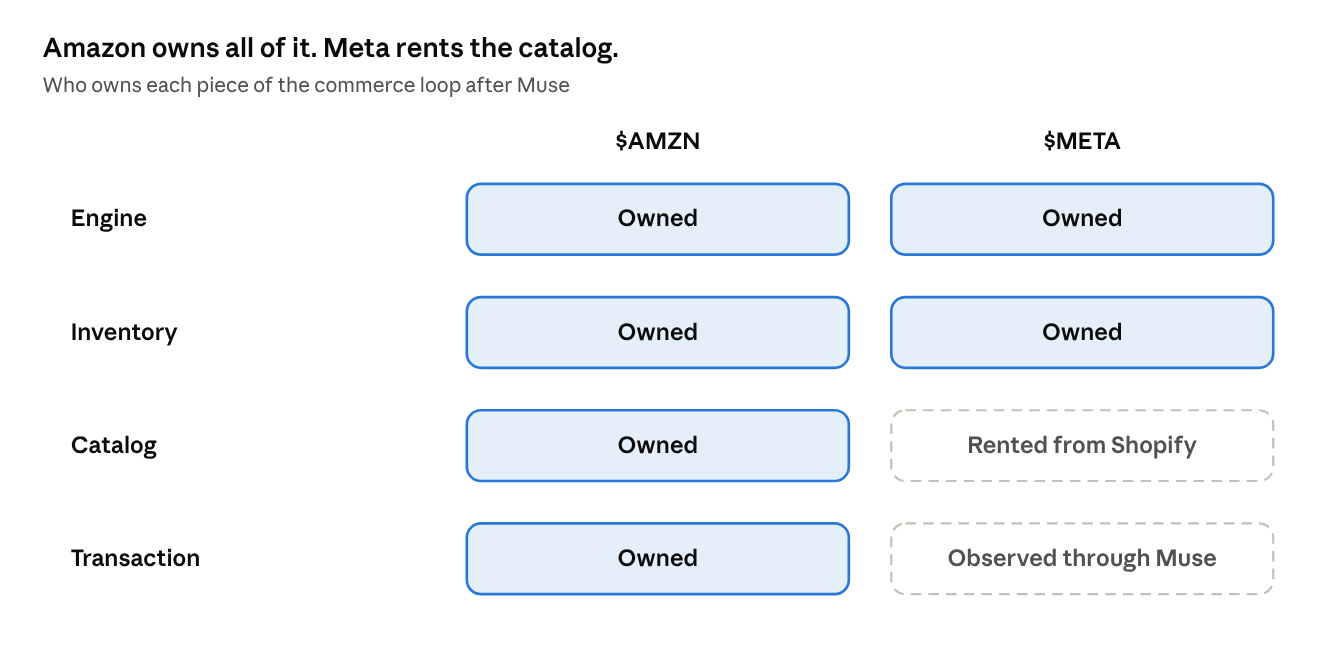
Engine, inventory, catalog and transaction: who owns what
Let me know what you think.